
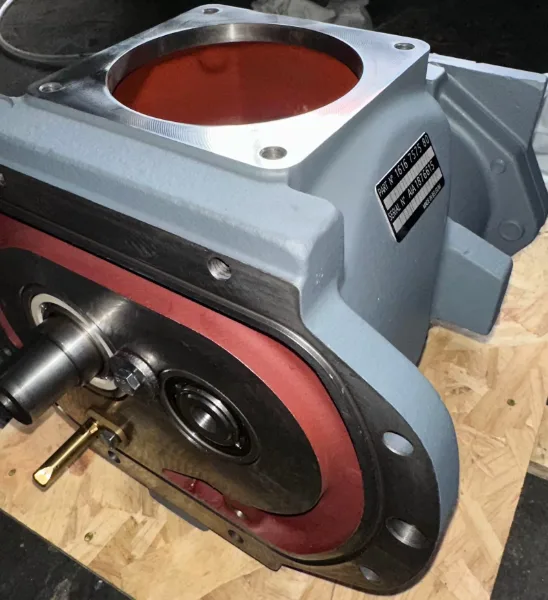
The short answer: identify an Atlas Copco air end by connecting the machine record to the removed-unit record. Use the complete compressor model and serial number, the full air-end part number and code, and photographs that show the nameplates and physical interfaces. Appearance and motor power can help organize the search, but neither is a safe ordering identity.
That distinction matters because a quotation is not simply a photograph with a price. It is a written claim that a specific, orderable part belongs to a specific machine record. The evidence below gives maintenance, purchasing and supplier teams a common way to reach that claim.
Treat identification as a chain, not a single clue
A useful air-end identification has four layers. The first names the compressor. The second names the removed unit. The third checks whether the physical configuration agrees with those records. The fourth carries the result into the quotation. A weakness in one layer can often be compensated for by stronger evidence in the others, but no single photograph should be asked to do all four jobs.
Compressor model, complete serial number and the full machine nameplate.
Atlas Copco part number, air-end or element code and all visible revision markings.
Drive end, flange or feet, ports, connections and complete assembly views.
Exact supplied part number, product description, quantity and stated scope on the quotation.
Do not approve an air end from appearance, compressor power or a family name alone. The order should close on a part number supported by the machine serial record.
Begin with the complete compressor identity
Atlas Copco's own spare-parts guidance asks customers to provide the compressor serial number even when they already know the part number. The company also publishes several serial-number patterns, so a buyer should not reject a number merely because its length differs from an earlier machine. The most reliable action is simple: photograph the entire machine plate in focus.
The serial number connects the enquiry to a production record. The model tells the supplier which family to open; the serial number helps narrow that family to the applicable variant. This is why “GA55” or “XAS 186” can be a good search term but is not, by itself, an orderable air-end identity.
- Capture the whole plate, including the Atlas Copco name, model, serial number and rated data.
- Keep prefixes, leading zeros, spaces and punctuation exactly as shown.
- Take a second wider photograph showing where the plate sits on the machine.
- If a character is uncertain, send the photograph and mark the uncertain position instead of guessing.
Record the old air-end part number and element code separately
An Atlas Copco part number and an air-end code are not interchangeable fields. The part number is the commercial reference used to identify an orderable item. An element, stage or casting code may describe a design family or internal assembly and can be extremely useful during research, but it should not silently replace the complete part number on a purchase order.
Official Atlas Copco parts-list instructions ask for the part number, part name, quantity, machine type and serial number. They also show why context matters: in some lists, a choice between parts must be made according to the machine type or version. A bare number copied from a photograph is therefore strongest when it remains attached to the machine record.
Photograph the features that separate similar assemblies
A product photo is valuable when it answers a specific question. A close-up of one painted surface rarely does. Start with the complete unit and work toward the interfaces. The exact checks vary by technology, but the following set gives a supplier enough context to ask better follow-up questions.
Machine plate and old air-end or element plate, photographed straight-on and in focus.
Two or more wide views that show the housing shape and attached components.
Shaft, coupling, gear or pulley interface without covers hiding the connection.
Feet, flange, bolt pattern and orientation relative to the compressor package.
Inlet, discharge and relevant lubrication or cooling connections where visible.
One close view and one angled view; side lighting can reveal shallow stamped characters.
Do not crop out adjacent parts merely to make the air end larger. Sometimes the relationship between the element, gearbox, separator vessel or drive reveals more than a perfectly isolated product shot.
Use a minimum data set that another person can audit
A good request for quotation lets the supplier reproduce the identification without relying on a private chat history. It should contain the records below in one email, form submission or attached worksheet.
Minimum data set for air-end identification
- Machine
- Model, complete serial number and full nameplate photograph.
- Removed unit
- Complete part number, element or stage code and label photograph.
- Physical record
- Complete unit, drive, mounting and connection views.
- Requirement
- Quantity, destination country, required timing and any document needs.
- Written result
- Exact supplied part number, product identity and scope on the quotation.
Confirm genuine-parts evidence and fitment as different checks
Authenticity asks whether the supplied item and its packaging are genuine. Fitment asks whether that item belongs to the identified machine. Atlas Copco describes packaging labels, standard identification numbers and QR-code checks as genuine-parts evidence. Those checks are important, but a valid package does not by itself prove that the part number is correct for a particular compressor.
Supplier identity, quotation, packaging, label, part number and applicable QR or identification checks.
Machine model and serial number, old-unit identity, applicable parts information and written reference confirmation.
Condition on receipt, package seal, complete unit and the features needed for receiving inspection.
Quoted number, ordered number, received number, quantity, delivery documents and any explained number change.
The professional answer is not “the photo looks right.” It is “the genuine supplied part number has been checked against the machine record, and the same number appears on the quotation and receiving documents.”
Frequently asked questions
What information is needed to identify an Atlas Copco air end?
Start with the complete air-end part number, any element or stage code, the compressor model, the complete machine serial number and clear photographs of both nameplates. Add full views of the removed assembly, drive end, mounting and connections when the label is incomplete or when related references must be separated.
Is the compressor model enough to order an air end?
Usually not. A model family can include production revisions, pressure variants or different assemblies. The machine serial number and the old air-end identity provide the additional evidence needed to select the applicable parts record.
Where is the compressor serial number located?
Atlas Copco states that the serial number is on the number plate fitted to the compressor or dryer. Photograph the complete plate rather than sending only a typed sequence, because prefixes and surrounding machine data are useful during verification.
Can two air ends that look the same use different part numbers?
Yes. A similar housing does not establish the internal configuration, revision, drive arrangement or machine applicability. Visual comparison is supporting evidence; it should not replace the part number and serial-number record.
What if the old part number differs from the number on the quotation?
Ask the supplier to state the relationship in writing. The quoted number may be a current service reference, but the buyer should retain the old number, new number, machine serial number and explanation in the purchasing record before approval.
Can an air end be identified when its nameplate is unreadable?
Identification may still be possible from the machine serial number, service documentation, earlier invoices and detailed photographs. More physical checks will be needed, and the final quotation should record the evidence used rather than relying on appearance alone.
Official references used for this article
Technical statements were checked against the Atlas Copco resources below. Links are provided so maintenance and purchasing teams can inspect the original context.
- Atlas Copco: Where do I find the serial number?Official one-page reference showing that the serial number is on the compressor or dryer nameplate and that several serial-number formats exist.
- Atlas Copco: Spare Parts Questions and AnswersOfficial enquiry guidance asking for the compressor serial number, part number when available, quantity and a nameplate photograph.
- Atlas Copco: LFx 2.0 Compressor Spare Parts ListOfficial parts-list instructions requiring the part number, part name, quantity, machine type and machine serial number when ordering.
- Atlas Copco: How to identify genuine compressor spare partsOfficial guidance on packaging, labels, identification numbers and QR-code checks used to assess genuine-parts evidence.
Written and reviewed by the Aisipu Air End Team on July 27, 2026. Aisipu is an authorized Atlas Copco supplier. The article is an independent buyer resource and was not reviewed by Atlas Copco.
Request a Quote
Send us the part number or machine model and serial number. A clear old-unit or nameplate photo helps us confirm the correct genuine Atlas Copco air end and quote faster.